A REFLECTIVE PAUSE: break space on Sauchiehall street

A REFLECTIVE PAUSE: break space on Sauchiehall street
Saloni Agarwal
The project records a semester long study of understanding entertainment as an experience of a space rather than solely being an activity or program. The project explores how everyday urban environments can be changed to slow perception, create heightened awareness and create moments of pause. Through mapping, case studies, theoretical readings and reflection on talks/workshops; the iterative design displays an evolving understanding of space as an embodied experience.
The project’s setting is in Sauchiehall Street in Glasgow. It’s a bustling commercial street full of people, shops, signs and movement. It looks lively in a glance but when looked at closely it reveals a complex story.
The project starts by drawing attention to these overlooked fragments. The focus is not on decay but rather the clues that indicate that the street is changing.

Robert McKee describes storytelling as a layered experience. This means that when you watch a story, it works on two levels at the same time (Mckee, 1997). This theory of layered experience can be applied spatially in entertainment space where the space has immersive environments that engage the senses but also encourage a person to think and reflect.
So, in an essence, entertainment creates a feeling of awe (Magic) on the surface and embodies a greater associated meaning on a deeper level that represents something (symbol). These are the keywords taken forward as key principles for concept development.

The concept is progressed by raising questions: How to create attract point, sense of awe and wonder in a small space? What are the symbolic elements that encourage people to think and feel? How to play with threshold and transition? How will the user interact with the space?
Early sketches tested the concept on the site. It had bold thresholds and heavy layering with a lot of activities onto the site. They built the foundation for compression and transition but were toned down to fit in the site’s scale. Merging arrival and transition allowed more space for larger reflection and pause interiors. The spaces were allocated to ensure not more than one column falls in each room. The journey initially ended with a transition, but the pause allowed the user to re-orient before exiting.
DESIGN DEVELOPMENT
1. The pause room before exit was initially thought of as a living space which was too literal.
2. The curtain room didn’t define what the users were doing in the space, and why blue?
3. Sections of cupboard room was not easily accessible and user activity in the room was not defined.
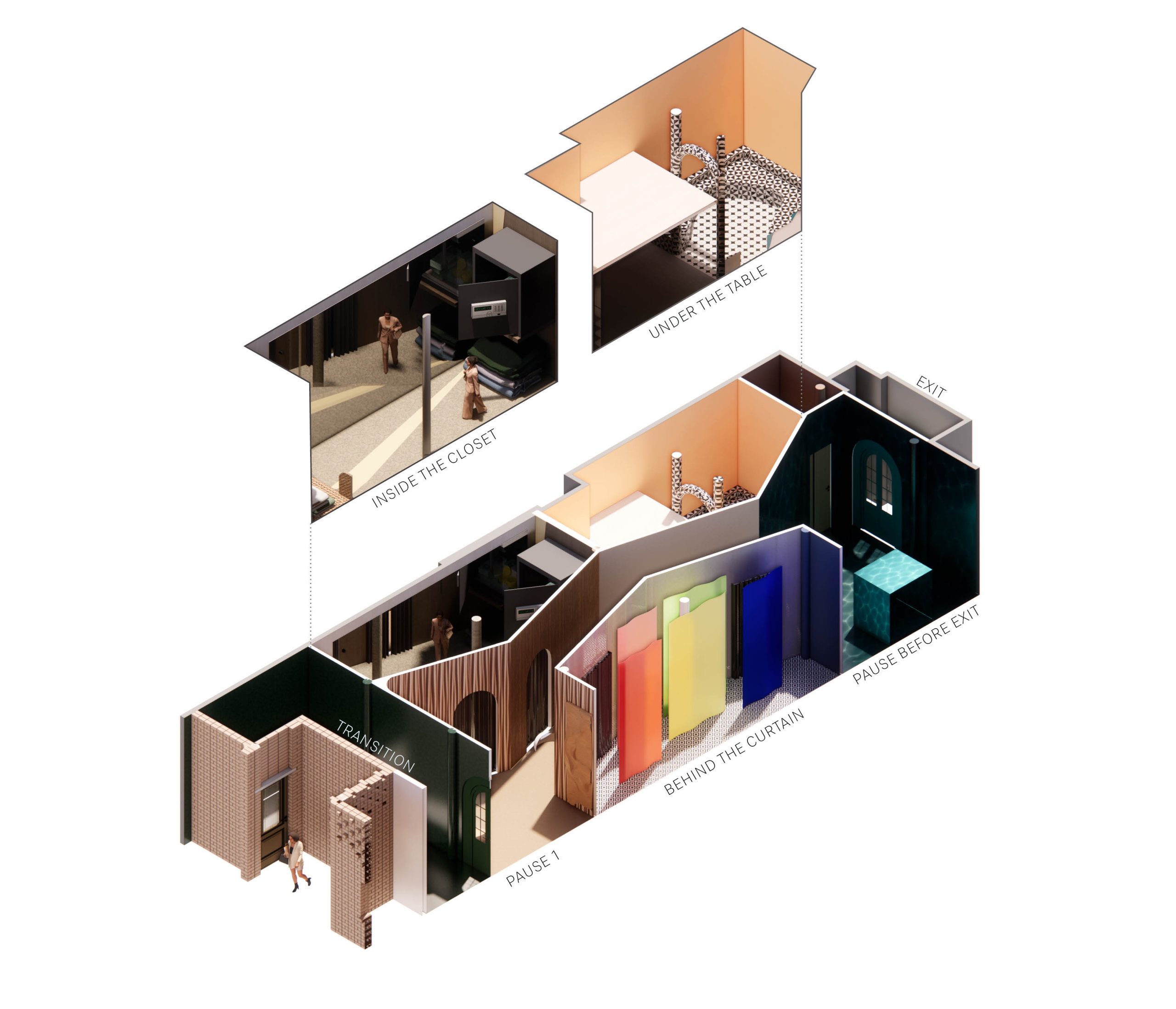
The user is then transported into a world of pause and introspection through a transition passage that leads to a warmly lit room for sensory offload. At this point the user can see a narrow corridor with three arched curtain concealed doors with a blue floating glow at the end of it. The user travels through each room which are sub worlds, ends the experience with an immersive pause space and then exits from the back gate leading to Sauchiehall lane.
The change in heights and their role in shaping compression and release. The transition space has a high ceiling, maximizing reflections and giving an enormous sense, an immersive threshold. The first pause compresses to a lower ceiling to foster intimacy, which gradually increases to a higher ceiling in the pause before exit space.
The under the table rooms requires people to take off their shoes and bend down to enter the low- ceilinged space, slowing and directing body movement, creating awareness.

The journal screams of entertainment as an experience rather than a function. The project celebrates the art of noticing details, slowing down perception to create heightened awareness.
The overlooked fragments of the street were subtle cues to designing a space to draw focus on the hidden details. Theoretical references anchor the idea of the body as an embodied experience. The design played with threshold, transition, controlled visibility, exaggerated scale and colors to generate curiosity, creating spaces to pause for introspection.
The project taught me that every corner of the street holds a story waiting to be told and we as designers can extract them, reinterpret them and present them in a way that others see and feel them too.
